SOLID Principles in the Age of AI
Why Classic Software Design Matters More Than Ever.
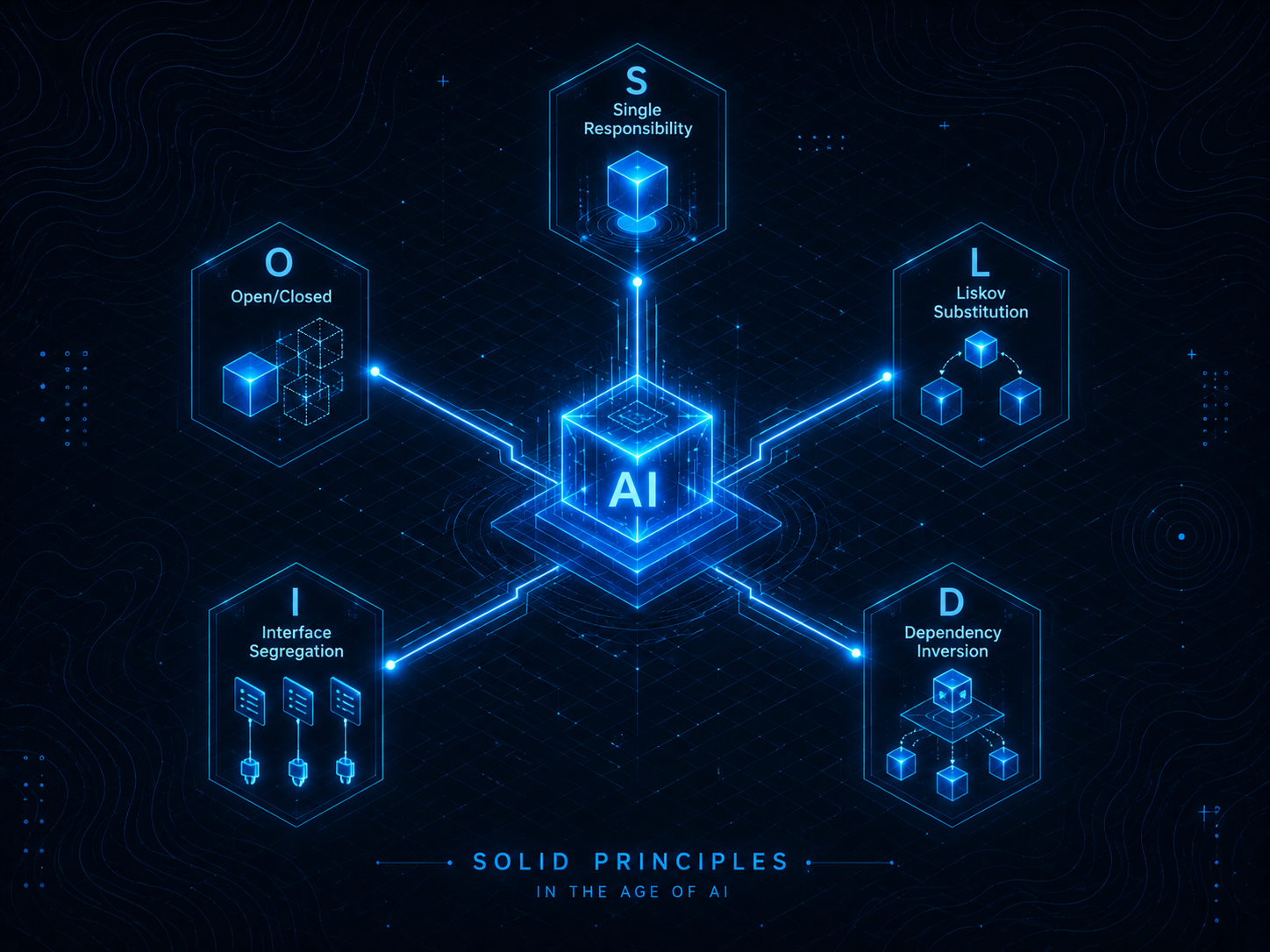
AI is changing how software is designed, built, and operated. Large language models can generate code, summarize data, call tools, reason across workflows, and increasingly act as autonomous or semi-autonomous agents. With agentic frameworks, we are no longer only writing deterministic functions that execute predefined instructions. We are building systems that interpret goals, choose actions, call services, delegate work, and respond dynamically to changing context.
That makes software architecture less important, right?
Actually, it makes architecture more important.
As AI becomes more capable, the temptation is to let models absorb complexity: bigger prompts, more tools, more memory, more orchestration, more agents, more “just let the model figure it out.” But complexity does not disappear just because an LLM is involved. It usually becomes harder to see, harder to test, and harder to control.
That is why foundational design principles like SOLID still matter. In fact, they may be even more important in the age of AI.
SOLID was originally framed around object-oriented software design, but its value is much broader. At its core, SOLID is about managing complexity through clear responsibilities, stable contracts, replaceable components, and dependency boundaries. Those same ideas apply directly to AI systems, agents, tools, prompts, workflows, and agentic frameworks.
AI Does Not Eliminate Design Problems
One of the biggest misconceptions about AI-assisted development is that it reduces the need for disciplined engineering. Because models can generate code quickly, it is easy to confuse speed with sustainability.
AI can produce working code. It can scaffold applications. It can wire together APIs. It can generate tests, documentation, and configuration. But AI does not automatically produce good architecture. It does not inherently know the long-term boundaries of a business domain. It does not understand organizational ownership. It does not guarantee maintainability, security, observability, or correctness.
In traditional software, poor design often reveals itself through duplicated logic, fragile dependencies, and tightly coupled systems. In AI systems, poor design shows up in additional ways:
- Agents are given too many responsibilities.
- Prompts become massive and brittle.
- Tools overlap in confusing ways.
- Memory is used as a dumping ground.
- Outputs are difficult to validate.
- Model providers become deeply embedded in business logic.
- Small changes create unpredictable behavior.
- The system works in demos but fails under real operational pressure.
This is exactly the type of complexity SOLID was created to address.
Single Responsibility Principle: Give Each Agent a Clear Job
The Single Responsibility Principle says that a component should have one reason to change. In traditional software, this means a class, module, or service should focus on one responsibility.
In agentic systems, this principle applies beautifully.
An agent should have a clear role. A research agent should research. A planning agent should plan. A coding agent should write or modify code. A validation agent should check outputs. A routing agent should decide which specialized capability should handle a task.
When one agent is responsible for everything, it becomes difficult to reason about its behavior. The prompt grows. The toolset expands. The agent starts making decisions across too many concerns. It becomes harder to evaluate, harder to debug, and harder to improve.
A single “do everything” agent may feel powerful, but it often becomes the AI equivalent of a god object.
A better design is to create focused agents with well-defined responsibilities. For example, instead of one agent that handles an entire customer onboarding process, the workflow might include:
- A classification agent that determines the type of request.
- A data retrieval agent that gathers relevant account information.
- A policy agent that checks business rules.
- A communication agent that drafts the response.
- A verification agent that reviews the final output before action is taken.
Each agent has a narrow purpose. Each can be tested independently. Each can be improved without rewriting the entire system.
The Single Responsibility Principle also applies to tools. A tool exposed to an agent should do one thing clearly. A vague tool like manageCustomerAccount is harder to control than specific tools like getCustomerStatus, updateBillingAddress, or createSupportTicket.
The more autonomous the system, the more important clear responsibility boundaries become.
Open/Closed Principle: Extend AI Systems Without Rewriting Everything
The Open/Closed Principle says that software should be open for extension but closed for modification. In other words, you should be able to add new behavior without constantly changing stable, working code.
This matters a great deal in AI systems because the ecosystem changes quickly. Models improve. New tools become available. Retrieval strategies evolve. Frameworks change. Business workflows expand.
A well-designed agentic framework should allow you to add capabilities without rewriting the orchestration layer every time.
For example, suppose you have an agent that can answer questions using internal documentation. Later, you want it to also search tickets, query a CRM, or inspect code repositories. A brittle design would require rewriting the core agent logic each time. A better design would allow new tools or skills to be registered through a stable interface.
The same applies to prompts and policies. Instead of hardcoding every rule into one giant prompt, you can separate instructions, policies, examples, retrieval sources, and validation logic. This allows the system to evolve without constantly destabilizing the core behavior.
In agentic architectures, the Open/Closed Principle encourages plugin-style thinking:
- Add a new tool without changing the agent runtime.
- Add a new model provider without changing business logic.
- Add a new evaluator without changing the workflow.
- Add a new agent role without rewriting the orchestrator.
- Add a new memory backend without changing every agent.
This is especially important because AI systems are rarely “done.” They improve through iteration. Good architecture makes iteration safer.
Liskov Substitution Principle: Agents and Tools Need Reliable Contracts
The Liskov Substitution Principle says that one implementation should be replaceable with another implementation of the same abstraction without breaking the system.
In AI systems, this principle becomes critical when swapping models, tools, agents, or retrieval systems.
For example, you may start with one model provider and later move to another. Or you may use one vector database in development and another in production. Or you may replace a simple rules-based classifier with an LLM-based classifier. If the rest of the system depends on specific quirks of the original implementation, substitution becomes painful.
This principle applies directly to agents as well.
If a workflow expects a “review agent” to return a structured response with approved, issues, and recommendations, then any replacement review agent must honor that contract. It cannot suddenly return a vague paragraph and expect downstream automation to keep working.
Agentic systems need strong contracts around:
- Inputs.
- Outputs.
- Tool schemas.
- Error handling.
- Confidence levels.
- Decision formats.
- Escalation behavior.
- Permissions.
- Side effects.
Without these contracts, agents are not truly replaceable. They are just loosely connected prompts with unpredictable behavior.
Structured outputs, schemas, typed tool interfaces, and clear validation rules are not boring implementation details. They are what make AI systems operable.
The more probabilistic the reasoning layer becomes, the more deterministic the boundaries around it need to be.
Interface Segregation Principle: Do Not Give Agents More Than They Need
The Interface Segregation Principle says that consumers should not be forced to depend on interfaces they do not use.
In AI terms, this means an agent should not be given access to every tool, every API, every document, and every possible action unless it truly needs them.
This is one of the most practical SOLID lessons for agentic frameworks.
When an agent has access to too many tools, several problems appear. It may choose the wrong tool. It may become slower. It may increase cost. It may create security risk. It may produce harder-to-debug execution paths. It may take actions that are technically available but contextually inappropriate.
A focused tool interface improves both performance and safety.
A scheduling agent may need calendar availability, meeting creation, and attendee lookup tools. It probably does not need access to billing records, deployment pipelines, or customer deletion functions.
A code review agent may need repository read access, static analysis results, and pull request comments. It probably should not have production deployment permissions.
A research agent may need search and retrieval tools. It does not necessarily need write access to business systems.
Interface segregation in AI is also about context management. Agents should receive the information they need, not an indiscriminate pile of context. More context is not always better. Irrelevant context can distract the model, increase token usage, and degrade output quality.
Good AI architecture asks: what is the smallest set of tools, data, permissions, and context this agent needs to perform its role?
That question is SOLID thinking applied directly to AI safety and system design.
Dependency Inversion Principle: Depend on Abstractions, Not Model-Specific Details
The Dependency Inversion Principle says that high-level policy should not depend on low-level implementation details. Both should depend on abstractions.
This may be the most important SOLID principle for modern AI systems.
It is tempting to build directly around a specific model, framework, vector store, or vendor SDK. That can be fine for a prototype. But production systems need separation between business logic and infrastructure choices.
Your business workflow should not be deeply coupled to one model provider. Your agent orchestration should not be inseparable from one framework. Your retrieval logic should not assume one database forever. Your evaluation layer should not be locked into one specific prompt format.
Instead, AI systems should depend on abstractions:
- A model interface rather than a specific LLM provider.
- A retrieval interface rather than a specific vector database.
- A tool interface rather than direct API calls scattered through prompts.
- A memory interface rather than one hardcoded storage mechanism.
- An evaluation interface rather than ad hoc manual inspection.
- A policy interface rather than rules buried inside prompts.
This makes systems easier to test, replace, secure, and evolve.
Dependency inversion also helps with governance. If all model calls pass through a standard abstraction, you can centralize logging, tracing, cost tracking, retries, redaction, safety checks, and evaluation. If every agent calls models directly in its own way, observability becomes fragmented.
In the age of AI, dependency inversion is not just about clean code. It is about operational control.
SOLID Helps Make Agentic Systems Testable
Testing AI systems is difficult because outputs can vary. The same input may not always produce the same response. Models can be sensitive to wording, context, temperature, tool results, and hidden state.
SOLID does not eliminate this challenge, but it makes it manageable.
When responsibilities are separated, each part can be evaluated independently. When interfaces are narrow, tests are easier to define. When contracts are explicit, outputs can be validated. When dependencies are abstracted, models and tools can be mocked. When behavior is extended through stable boundaries, regression risk is reduced.
For example, you can test whether a routing agent chooses the correct specialist. You can test whether a tool returns the expected schema. You can test whether an evaluator catches unsafe or incomplete responses. You can test whether a replacement model still satisfies the same output contract.
Without these boundaries, testing becomes vague: “Ask the big agent a bunch of questions and see if the answers look good.”
That is not enough for production-grade AI.
SOLID Also Helps Humans Collaborate With AI
Another reason SOLID matters is that AI is changing the development process itself. Developers are increasingly working with AI coding assistants, copilots, and autonomous coding agents.
These tools perform better when the system has clear structure.
A well-factored codebase gives AI better context. Clear interfaces help AI generate correct implementations. Smaller modules reduce the chance of unrelated changes. Good abstractions make refactoring safer. Strong tests give AI-generated changes a feedback loop.
In contrast, a tangled codebase gives AI more opportunities to make confident mistakes. When responsibilities are unclear, AI may modify the wrong layer. When dependencies are hidden, AI may introduce regressions. When contracts are informal, AI may generate code that works locally but breaks the larger system.
SOLID principles are not just for human maintainers anymore. They make the codebase more legible to AI collaborators as well.
The Future Belongs to Clear Boundaries
AI systems are moving from passive assistants to active participants in workflows. They retrieve information, call APIs, update records, write code, generate plans, and make recommendations. As this happens, the boundary between software architecture and AI behavior becomes increasingly important.
The lesson is not that every AI system needs heavy enterprise architecture. The lesson is that autonomy without structure is fragile.
SOLID gives us a practical vocabulary for that structure:
- Single Responsibility keeps agents focused.
- Open/Closed makes systems extensible.
- Liskov Substitution makes components replaceable.
- Interface Segregation limits unnecessary exposure.
- Dependency Inversion protects business logic from infrastructure churn.
These principles may have come from object-oriented design, but they are not trapped there. They are principles for managing change. And AI is accelerating change.
In the age of AI, the best systems will not be the ones that simply use the most powerful models. They will be the ones that combine powerful models with disciplined architecture, clear contracts, thoughtful boundaries, and responsible control.
SOLID is not old-fashioned.
It is exactly the kind of engineering discipline AI needs.